Baby Chakraborty, Kolkata:- She remembered Swamiji’s assuring letter – ‘Whether you work for the welfare of India or not, whether you renounce Vedanta or remain a Vedantist, I will help you till death.’
One can depend on such a guru. A new chapter in the life of the one who takes shelter, there was no doubt about the ultimate shelter-sacrifice.
The time was March 18, 1898. Venue – Star Theatre. On this day Nivedita lectured here.

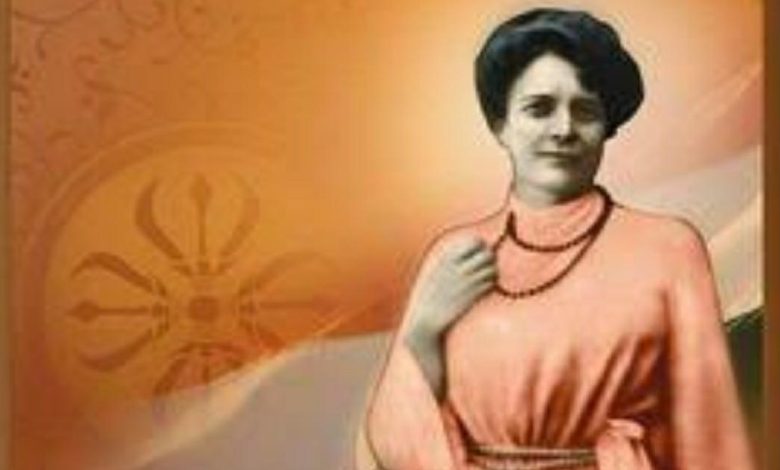
Her first speech on Indian soil. President Vivekananda himself. Swami Vivekananda’s sister Nivedita was introduced to Calcutta’s Vidwajjan society
Did it. Saying, ‘Nivedita is the fairest flower of my work in England-Nivedita is the fairest flower of my work in England.’
Hearing this, there was a loud cheer in the meeting. At the request of Ramakrishna’s Bhairav, Nataguru Girishchandra, Swamiji then called the disciple to the lecture stage. The subject of the lecture was ‘The Influence of Indian Spiritual Thought on England.’
A large number of people gathered to hear the speech of the foreign disciple of the world champion Vivekananda. As soon as Nivedita stood up and addressed the assembled audience, ‘My friends and compatriots’, there was loud applause from all sides. Everyone listened to Nivedita’s speech spellbound. The master’s chest swelled with pride and joy at the disciple’s success.
Sister Nivedita used to come to teach Rabindranath’s daughter at Jorasanko’s house in Kolkata. Nivedita initially misunderstood Swamiji when he objected to Nivedita’s teaching when he went to this Tagore family. And in his early life, Rabindranath was serious – arrogant – arrogant. Mastery resides in dominant meditation. One of his examples was the claim of path by noted novelist Saratchandra Chatterjee and his opposition and closure in Dhumketu Patrika. Just at this time sister Nivedita again realizes her mistake.
At the end of April 1898 there was a sudden outbreak of plague in Calcutta. Swamiji then went to Darjeeling for rest. She could no longer rest assured after receiving the news of the plague. Hastily returned to Calcutta and settled the patient-nursing. There was chaos in Calcutta. Government regulations for the plague caused great panic in the public mind. Many are leaving the city. Returning to the monastery, Swamiji called Nivedita. A declaration to him
He asked to prepare the draft, the monks of the Ramakrishna Mission would serve the afflicted. Nivedita carefully drafted a manifesto. Every word of the manifesto expresses the call to service in poignant language. Swamiji translated it into both Bengali and Hindi. Under the leadership of Vivekananda, the Ramakrishna Mission was being created to serve the downtrodden. A Gurubhai said, ‘Where will the money come from?’
Hearing this, Vivekananda said, ‘Why? If necessary, I will sell all the land of the new monastery. We can spend our days as fakirs, begging and lying under trees. If the question of thousands of people can be saved by selling the land, what is the land and what is the land?’
Nivedita also heard this. He got another identity of Guru. This is not about a monk, he discovered a human lover in the secret of a monk’s life. Realized that his Guru did not waste time with dry philosophical judgments nor was he idle with verbal exhortations. He follows what he says in his actions. Inspired by this living ideal, he too started moving forward. Nivedita herself came down to clean the road with a broom. The Guru was amazed to see that his disciple was not just a worker, but an eternal Florence Nightingale, like an idolatrous servant.
Three months after coming to India at Swamiji’s call, we find Sister Nivedita happily devoting herself to the service of plague patients, disregarding her own life. In those days this scene was very rare.
Referring to this incident, Sir Jadunath Sarkar later wrote:- ‘What a panic it was in Calcutta during the plague of 1898. The city dwellers had no prior acquaintance with this epidemic. It became difficult to get a sweeper to clean the streets of Kolkata. One day on the street of Bagabazar, I saw a white woman with a broom and a spade cleaning the street garbage herself. Feeling ashamed of his example, the youth of Bagbazar Palli finally took to the streets with brooms. Later I heard this foreigner sister Nivedita.
Swamiji left this world on July 4, 1902 between 9.02 and 9.10. At that time his head shook for once. The pillow moves away from the head. At that time Vivekananda’s face had a wonderful light and smile. Before that, around 7 pm Swamiji went to his room and started chanting Mala. Bengal told Brajendra, ‘I will not come unless I call’. Then at 7.45 minutes he told the servant to press his leg. Then he started crying like a baby. Then between 9.02 minutes and 9.10 minutes he died in his room. After the passing of Swami Vivekananda, the world poet Rabindranath Tagore himself publicly acknowledged Swamiji’s ideals – principles of unimaginable strong spirituality. He later referred to sister Nivedita as the “Lokmata” of India.
Swami Vivekananda said that Advaita philosophy saved India twice from materialism, once by Lord Buddha who developed its moral aspect, then by Sri Shankaracharya, who developed its strictly intellectual aspect. Advaita, through the appearance of Sri Ramakrishna, saved India and the world for the third time. Sri Ramakrishna not only re-established its moral and intellectual aspects but also made it intensely practical and accessible to all.
This year the birth anniversary of Adi Shankaracharya falls on 12th of this month.
It is said that once someone asked Shankaracharya to give a brief account of his teachings. Shankaracharya replied:- “Brahma satyam, jagat-mithya, jiva brahmaiva napar:” Only Brahman is real, this world is mere form, and you are none other than Brahman.
We present below some key words of Sri Shankar.
As ignorance imagines a piece of rope as a snake (in semi-darkness) and an oyster as a piece of silver, so the soul is determined to be the body of an ignorant person. Just as a tree stump is considered to be a human form and a mirage to be water, so the soul is determined to be the body of an ignorant person. The illusion of samsara is only due to an illusory concept and is not an absolute reality. The soul is indeed one and without parts, whereas the body consists of many parts; Yet people see these two as one! What can be said other than ignorance?
Karma cannot destroy ignorance, because it does not conflict with ignorance. Only knowledge destroys ignorance, as light destroys darkness.
Ignorance makes the soul seem finite. When ignorance is destroyed, the Self, which admits of no multiplicity, reveals itself in truth
itself, like the sun when the clouds are removed. Avidya or ignorance, ineffable and eternal, is called reason, which is an epithet applied to the soul. Just as the movements associated with water are, through ignorance, attributed to the moon reflected in it, so also agency, enjoyment, and other limitations of the mind are falsely attributed to the soul. Just as trees are considered by a man to move in opposite directions to a moving boat, so the moving existence is considered to belong to the soul.
Our first lesson in self-reliance in civic life was from Sister Nivedita. It was on the occasion of this plague that I first met him.’ One day during this plague, a plague-stricken child died in Nivedita’s arms. Only Nivedita could have cared for a patient suffering from such a disease. slowly
Nivedita won the hearts of Bengalis.
A few days after his arrival in India he met Sarada Devi, the wife of Ramakrishna Paramahamsa. Then on March 25 Swami Vivekananda Nilambar Mukhopadhyay’s garden house initiated him into celibacy. He gave Margaret’s new name ‘Nivedita’.
To teach girls education, Nivedita opened a girls’ school at her residence at 16 Bospara Lane in Bagbazar area of North Kolkata, now named Ramakrishna Sarada Mission Bhagini Nivedita Balika Vidyalaya. When an epidemic broke out in Calcutta in 1899, he served the sick and did village cleaning with the help of local youths. No. 16 Bose Para Lane, Sister Nivedita lived.
He felt the need to join the anti-British nationalist movement. But according to the rules of Ramakrishna Math and Mission, no one from the Sangh could get involved in politics to prevent the fusion of religion and politics. So Nivedita had to give up the official relationship with the mission. However, he remained on good terms with the monks of Sarada Devi and the Ramakrishna Mission until his death.
During the anti-partition movement of 1905 AD, Nivedita secretly started helping the revolutionaries. During this time, he got acquainted with prominent Indian personalities like Arvind Ghosh, Rabindranath Tagore, Abanindranath Tagore, Jagadish Chandra Bose. Besides these, Nivedita used to write articles on religion, literature, politics, sociology, art etc. His notable books are ‘Kali the Mother’, ‘Web of Indian Life’, ‘Cradle Tales of Hinduism’, ‘The Master as I See Him’ etc.
In the last phase of his life, Nivedita got involved with the freedom movement.His affinity with Sri Aurobindo was established. At this time, he renounced his “official” relationship with the Mission to prevent the British Government from harassing the Ramakrishna Mission unduly.
Sister Nivedita over worked with Sarada Devi and Nivedita fell ill within a few years. Nivedita went to Darjeeling with Jagadish Chandra Bose and his wife for a change of air. He breathed his last at Darjeeling on 13 October 1911 at the age of 44.