Baby Chakraborty, Kolkata:- India is a sovereign democratic secular state. Nationalism in India is linked to the past and the present.
Education was needed to remove the gloom of the oppressed India full of misery and poverty, education is the backbone of the people. So to educate the human society, Swami Vivekananda said, “First the mother is educated, then her child will be educated”. So Swamiji thinks that women education is necessary to make the society educated.
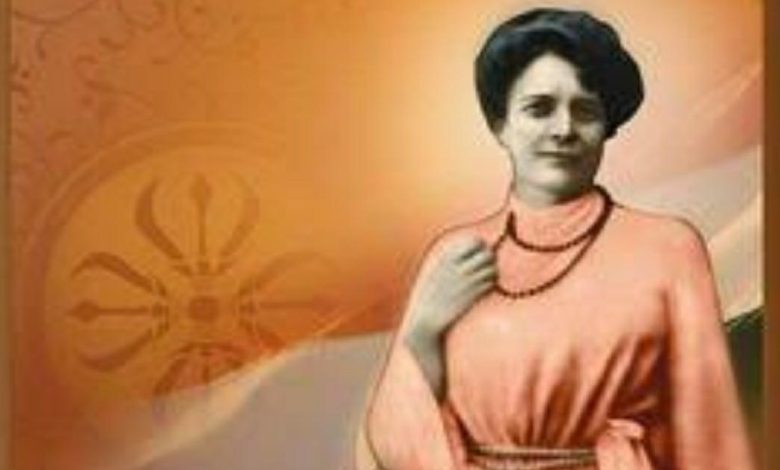
On October 28, 1867, a noble woman was born in Vangane, Taiyon to the patriotic priest Samuel Richman and mother Mary Isabel – she was none other than Margaret Elizabeth Noble. Margaret’s family was from Scotland. When her father died at the age of 34, Mary Isabel left Scotland and moved to her father’s home in Ireland.
Then Margaret passed the school examination in 1884.She became a teacher and writer at the age of 17. Later he realized that samsara was not for him. Eventually he concentrated himself in religious work.

Church discipline was conversion for money. It was customary to convert poor people by tempting them with money. Margaret then wonders if religion is so narrow that not everyone can accept it honestly. This kind hearted mind of his developed into a generous spirit in social service.
In 1890, he went to school together with Deleuze in London, but could not work with Deleuze for long due to Deleuze’s fiercely independent attitude. After that, he joined Semi Club in London and became sharp in terms of logic. He was not at all in favor of lifeless arguments.
In 1895, Swamiji went to London to preach Hinduism after finishing preaching in America. Swamiji met Margaret on November 16. “Every religion is best, every religion is true” – Swami Vivekananda’s argument about religion touched Margaret’s heart. In 1896 he went to London for the second time. Margaret’s presence at the Chicago Synod was desired, and Margaret attended. Vivekananda was impressed by his devotion to religion and logic. Later it was heard in the ecclesiastical synod that no religious arguments were held in Margaret’s absence.
Education is needed for the women of subjugated India. Realizing the need for women’s education at that time, he wrote to Margaret to come to India. “If you ever get angry at work you can tell me, you can work for India or not accept Vedanta religion or not you have to stand on your own feet”. Margaret then left for India. When he came to the ship wharf at Calcutta port, he saw that Swamiji himself had come to pick him up from the ship wharf.
He was in an old house near the Ganga in Bagbazar Lane No. 16, Bose Para, as the image of old Calcutta cannot be found exactly from Chowrangi Para. He said these gave me shelter. “My home in my eyes charming” also helped him to progress in mental and spiritual development. Nivedita was initiated into celibacy on March 18, 1894 – she gave herself completely to her as Swamiji called her ‘Nivedita’.
For the cause of women, he established a girls’ school at 16 Bose Para Lane in Bagbazar. Then Nivedita used to go from house to house and call everyone for women’s education and say, “Get up, don’t get up, wake up, don’t say that we are willing to give girls”. At that time, he went around barefoot and insulted how many girls he collected. He taught them drawing, handwork, sewing, education. During this time Swami Brahmananda, Swami Abhayananda used to help him.
Earlier the school was known as ‘Ramakrishna Mission’. Later came to be known as ‘Nivedita Balika Vidyalaya’. Then mother Sarada said, “I bless that the girl who studies from here will become an ideal girl”.
He devoted himself to the service of India throughout his life, respecting the traditional traditions of India. Human service was one of his ideals. Swami Vivekananda’s discourses and spirituality deeply influenced him. Although she was associated with the Ramakrishna Mission, she was both a fighter and a nun.
When the plague broke out in Calcutta, many people fled the city. The death toll was increasing. He did a lot of service by visiting the homes of those poor people. Swami Sadananda, Nityananda, Swami Abhayananda helped him a lot. Student youths like Jatin Das – Baghayatin came forward to support Nivedita’s work.
When Vivekananda decided to establish a Sanskrit college in Kashmir, King Hari Singh of Kashmir was ready to provide space for a Sanskrit college, but the British ruler opposed it. He wrote ‘Kali the Mother’ with intense maternal thoughts in the Kali way.He studied a lot on religion and literature and wrote his books ‘My Master as I saw him’ and ‘The Cradle Tables of Hindustan an Indian Study of Love and Death’.
Sage Aurobindo called him ‘Shikshamayi’ because he had endless education in Indian human service. Again Rabindranath called her ‘Lokmata’.
Nivedita also actively participated in the Indian revolutionary movement. The anti-British speech at the Benares Congress session in 1906 was a historic event. He was prominently associated with the Practice Society in Bengal.